
An Update from late July 2026 – from the Portland Press Herald
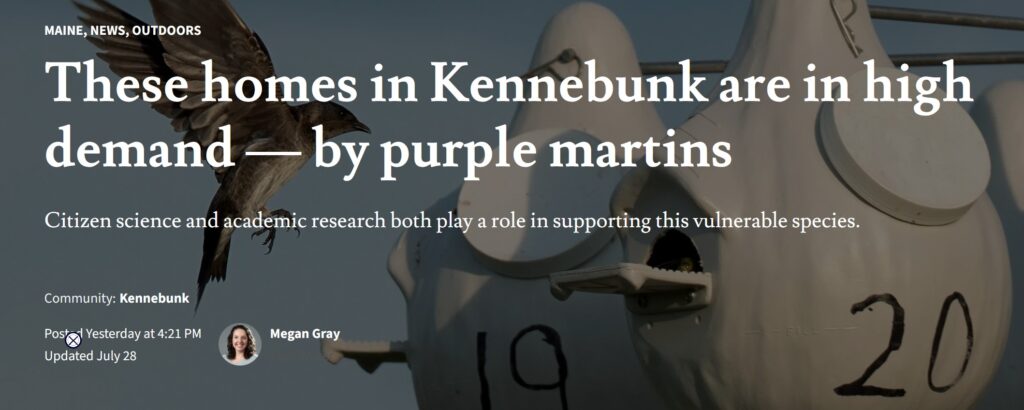
KENNEBUNK — Seven years. That’s how long the York County Audubon waited for purple martins to arrive at the Madelyn Marx Preserve. In 2017, the nonprofit built the special housing these birds need for their nests. Every spring, treasurer Kathy Donahue spent early mornings in the marsh, playing a recording of their song on her phone to attract the species.
By 2024, she had given up hope. But that year, she got the call. “Lo and behold,” Donahue said. “We had martins in all the holes.”
That first year, there were six nests. Last year, the York County Audubon added six more houses, and purple martins took up residence in all 12. This year, the nonprofit again doubled the capacity, and 22 of 24 nests were occupied in mid-July. Volunteers and students counted 89 chicks on a visit this month! Those numbers are a big deal in Maine, where purple martins are a species of special concern and experts say their numbers have plummeted by more than 90% in recent decades. Reviving this vulnerable population relies on both citizen science and academic research.
This species is in this conservation situation because of what humans have done,” said Joe Siegrist, president and CEO of the international Purple Martin Conservation Association. “But we hold the key to saving it.”

A RENEWED EFFORT
Muck boots squelched in the Madelyn Marx Preserve, a coastal salt marsh managed by the Kennebunk Land Trust. It was 6 a.m. and already humid on July 14.
Anna Forsman, an assistant professor of biology at Colby College, led three students from her lab down the soggy path. They walked with Donahue and other volunteers from the York County Audubon.
On top of two poles in the middle of the marsh were 24 white plastic gourds.
As the group approached, the trills became louder.
Historically, purple martins — the largest member of the swallow family and known for their blue-purple iridescence — nested in cavities, such as rock crevices or woodpecker holes in trees. In part because of habitat loss, their colonies east of the Rocky Mountains now rely almost entirely on manmade homes.
The birds flitted and swooped as students and volunteers set up a work station for the morning.
The day’s task was to band and sample as many adult purple martins as possible. Forsman is an ecological immunologist, which means that she studies how immune systems develop and function in nature. She and her students have been extracting DNA and other information from fecal and blood samples from the birds to learn more about their health and diet.
“When we have the opportunity to get our hands on these birds, we want to get as much data as possible,” said Forsman, who started working with purple martins at the University of Central Florida and moved to Maine three years ago.

The students set up tables with scales and other tools for taking measurements, as well as vials and slides for samples. In the meantime, volunteers from York County Audubon waited at the ready with their own instruments — paint rollers.
When a purple martin entered the gourd to feed the chicks inside, a volunteer would rush forward and block the entrance with the roller. Dorothy Liu, a rising junior studying computational biology, reached inside the nest and gently wrapped the bird in a canvas bag to be analyzed.
Liu placed the bird on a scale, while other students secured a small band on its leg and took measurements of its wings and head. Forsman cradled the bird in one hand as she drew blood. She added a second, bright orange band so the volunteers at this site would easily recognize the bird if it returns in future years.
Each of her students has a different focus.
Last year, Forsman spearheaded an unprecedented project. Purple martin “landlords,” or people who provide housing for the birds, gathered more than 800 fecal samples from across the eastern and central United States. In the lab, Liu has been extracting DNA from those samples to characterize diet across the breeding range.
Barlow Herbst, a rising senior studying biology and environmental science, is using fecal samples to see how the purple martins’ diet changes over the first three weeks after hatching. These birds are aerial insectivores, which means they eat flying bugs, and have seen significant impacts to their food source from pesticides and climate change, Forsman said.
Aichetou Ouattara, a rising senior studying cellular molecular biology and biochemistry, is screening the birds for avian malaria and studying their biomarkers associated with immune activity and tissue damage.
“The project that you start, someone who is coming after you can keep working on it,” Ouattara said. “The data never dies. People can add onto it.”

MAGICAL AND IMPERILED
The York County Audubon chose the Madelyn Marx Preserve to install the housing because there are similar gourds on a nearby private property, according to the organization.
Local volunteers play a critical role in supporting the species. They help year round, storing the gourds in winter, readying them for spring and regularly recording their observations about the birds throughout the season.
On July 14, they staked out the gourds with their paint rollers. With their assistance, Forsman and her students banded and documented more than a dozen adult purple martins in just a few hours.
“They are very mellow,” volunteer Brad Woodward said. “They’re very wary of us, but they’re not giving any alarm calls. They’re not dive-bombing.”

That morning, the work was buggy and muggy. Board member Britney Fox brought her two kids — 9-year-old Callum and 13-year-old Ainsley — to participate. Fox, who coordinates the Maine Young Birders Club, said she has been an avid birder for a decade.
“The second you enter this world, this whole universe opens up to you, and shows you how magical it all is and how imperiled it all is,” Fox said. “It’s so cool to be able to go out and appreciate it and know that you’re doing a small part to help.”
Nearby, Forsman helped the 13-year-old release a bird that had been banded. As everyone started to pack up their supplies, the kids chattered about their favorite details about the martins.
“They seem really smart,” the teenager reported back to her mom.
“I like the purplish dark blue,” her brother chimed in.
“It really allows people, my kids, to hands-on see them,” Fox said. “It changes people’s lives to see these things up close.”

An Update from September 2025
Purple Martins in Kennebunk: A Success Story!
York County Audubon is the proud surrogate of 46 Purple Martin fledglings! After eight years our efforts are yielding significant results.
In 2016-17, the YCA board considered the limited number of Purple Martin colonies in Maine – a Species of Special Concern in Maine – and committed to backing up the one on private land at the mouth of the Mousam River. Kennebunk Land Trust agreed to placement of a set of gourds on the Madelyn Marx Preserve within sight of the established colony, which we did in spring 2017. We thought the birds in the area would readily come to the new gourds, but they apparently had other ideas. Then, seven years later, when we had all but given up hope, Purple Martins occupied them in late May 2024!
After the breeding season, the gourd setup was refurbished for this year. During April and early May, Project Coordinator Kathy Donahue and UNE bird club president Haley Hines played the dawn recording and, “Yes!” the birds came.
Nine volunteers monitored for egg laying, hatching, and fledging. Dr. Anna Forsman, Assistant Professor of Biology at Colby College collected data on hatchling growth and diet (via fecal sac collection), and banded 35 chicks. Data will also be submitted to the Purple Martin Conservation Association, a nationwide organization promoting the species welfare. These represent the first Purple Martin data for the State of Maine.
In all, the project produced 58 eggs of which 46 hatched and fledged. This is an excellent result, and worth the wait.
This year’s success prompts us to expand efforts by erecting another set of gourds near the current one. Their purchase will cost about $1000.00. If you would like to support the project and “Adopt a Martin,” your help would be greatly appreciated.
Our Purple Martin Report from September 2024
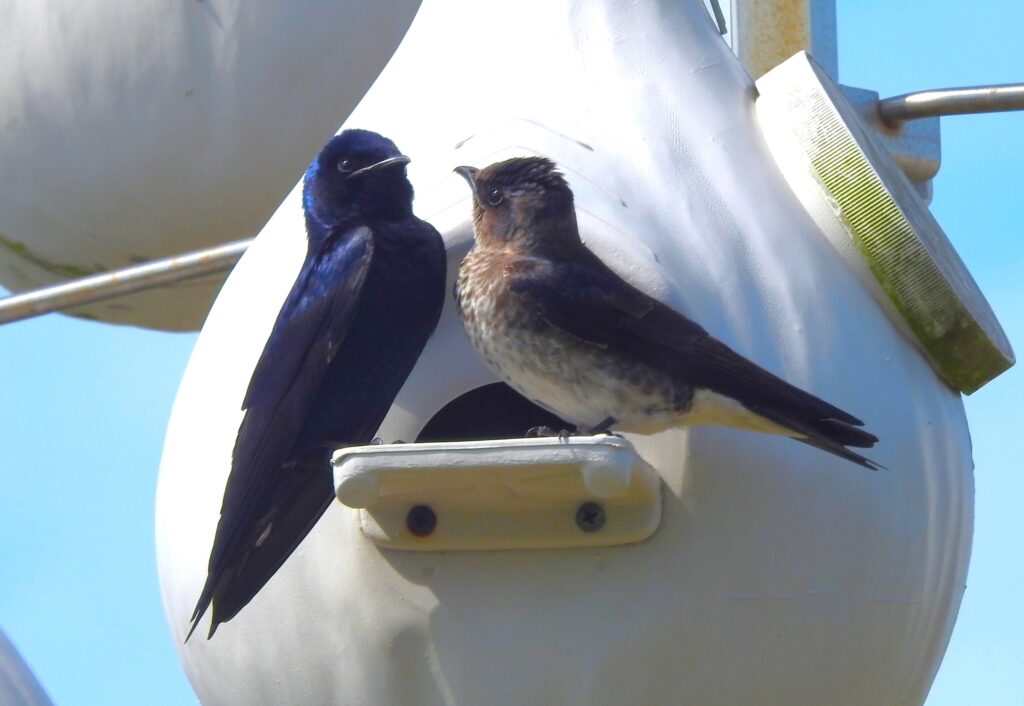
In 2016, Pat Moynahan suggested to the York County Audubon board that we should investigate putting Purple Martin housing up near the Mousam River. Joe McGovern and his family had maintained an active Purple Martin house on Great Hill Rd since the1990’s. The only colony in York County could disappear if the McGovern family stopped maintaining that house. So, the board decided that it would be a worthwhile project to try to expand the existing colony in the marsh near the Mousam River. It’s generally fairly difficult to establish a new Purple Martin nesting site. Positioning one within sight of an existing one generally has the best chance of success.
We talked to Dennis Skillman, Sue McGrath and others from NH Audubon who had successfully put-up Purple Martin gourds in the marsh in Seabrook, New Hampshire. They invited us down to their site to see their setup and share their expertise and they came up to Kennebunk to check out our proposed location. We worked with Gordon Collins from Kennebunk Land Trust to get permission to install the housing in the marsh on KLT land. The site is on the marsh near the Madelyn Marx trail. NH Audubon also recommended that we get in touch with the Purple Martin Conservation Association for information on Purple Martin housing set-ups.
In the fall of 2016, we installed the Purple Martin housing base pole in the marsh. We wanted to see how it would survive the winter since the marsh floods during very high tides. Then, in April of 2017, a group of YCA and KLT members installed the rest of the martin housing out in the marsh. Deirdre Fleming of the Portland Press Herald and Greg Rec, a photographer who lives in Kennebunk, attended, and this is the story from the Press Herald – https://www.pressherald.com/2017/04/23/birders-try-to-stem-the-decline-of-purple-martins
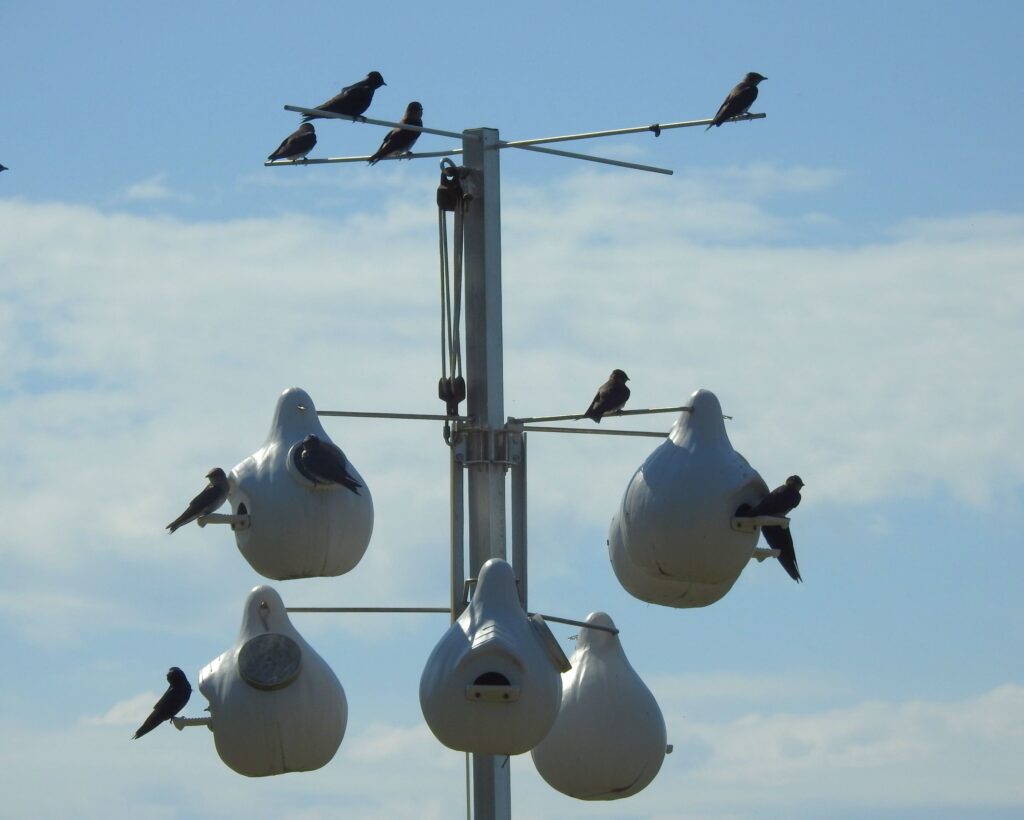
The first year we checked the gourds every few days. When Tree Sparrows attempted the nest in the gourds, it was recommended that we block the gourds and put up 2 bluebird houses nearby. This worked to dissuade the swallows, but we had no martins in the gourds the first year.
That first year, Martins returned to the existing house on Great Hill Rd on schedule in mid-April. Great Hill Road’s colony was successful as usual with about 15-20 birds.
Adult Purple Martins are the first to arrive in the spring. They take the preferred nesting sites and mates. Second year birds arrive a couple weeks later. We were expecting it would be second year birds who would nest in the gourds for the first year. Then, in subsequent years the adults that used the gourds before would prefer them to the Great Hill Rd house.
Each year we would put up the gourds in April adding a layer of pine needles. Blocking the cavities until the Tree Swallows started to use the Bluebird houses seemed to solve the Tree Sparrow issue. We could then open the gourds up in time for the sub-adult’s arrival. I would play the Purple Martin dawn song early in the morning a couple times a week to draw the martins’ attention to the gourds. But I was never able to figure out how to have the dawn song play daily automatically out in the marsh in that environment without electricity.
The martins migrate south in mid-August. We would wait until the fall to take down the gourds and store them for the winter. Each year we were disappointed but kept trying.
Over the past 7 years, we have occasionally seen martins on the gourds checking them out. Once, I saw a martin bring nesting material into a gourd, but we never had Purple Marins actually nest in them. The Great Hill Road site was still active but seemed to have fewer martins each year.
On May 25th, 2024, Magil Weber reported that there were martins at the gourds. I had been out there a few days earlier and had seen no activity. The next morning, I went to check and there were 10 martins actively using the gourds. It was a great sight to see!
As of July, it appears that all six gourds have nesting Purple Martins. The Great Hill Rd housing also has at least six nests. Because the pulley system on the pole needs maintenance, we weren’t able to lower the gourd system to count eggs and chicks. So, these numbers are guesses but there were about 20 Martins in and around the gourds last Saturday. Also, Purple Martin sightings in the area are up this year.
Next year, we plan to fix the pulley system so we can lower the gourds to monitor the martin activity throughout the season. The Tree Swallow houses need to be replaced. We can also add 6 more gourds to the current pole. We can report our monitoring results to the PMCA project adding to the citizen science.