Appreciate the Guillemot
By Nora Cioffi, a student at the Putney School who lives on Monhegan Island and was the 2026 recipient of the Coastal Maine Bird Studies for Teens scholarship provided by YCA’s Maine Young Birders Club and Friends of Hog Island
Upon arrival at Hog Island, I was immediately greeted by a group of very excited people attempting to find an Eastern Phoebe chick that had been spotted just minutes before. I, and the other people who came to the island on the same boat, rushed to get our bags to the rooms we stayed in, so afterwards we could get a look at the phoebes. A greeting activity of some sort had originally been planned for that time, but instead, it was spent looking for the fledglings.
After this, we were called away to look at a Roseate Tern. Many of the people there had never seen these birds, and it was amazing to see people so appreciative of a bird that I see regularly. Witnessing others so awed by birds I would usually brush off as uninteresting, such as a Tufted Titmouse, really changed my outlook on the more day-to-day birds, and I feel I have been appreciating them more since then.
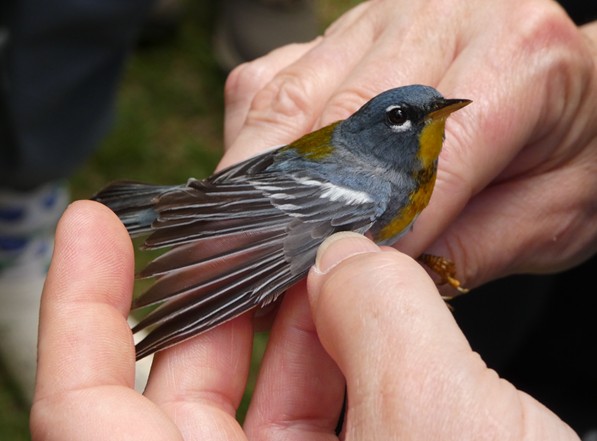
On my first day at Hog Island, one of the activities was bird banding. While campers were not able to band the birds, as that would not have been safe for the birds, some people were able to hold and release them. We watched one of the researchers measuring, weighing, and banding the birds. The birds banded were a Northern Parula (NOPA), Golden-crowned Kinglet (GCKI), and Red-breasted Nuthatch (RBNU).
On the second day, we visited Eastern Egg Rock and spoke to a resident seabird researcher. We did not land on the island, but she came out to the boat with us. She told us about the puffins and their nesting habits, as well as what living on Eastern Egg Rock is like.
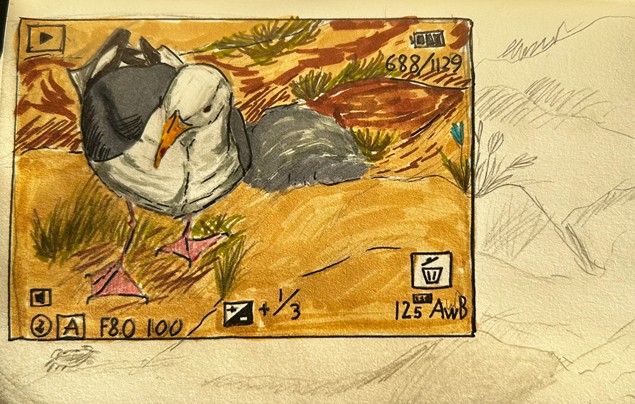
While visiting Eastern Egg Rock, we spotted a Parasitic Jaeger taking fish away from terns. This was the first time I had seen a jaeger, and was in awe of its flips and twists through the air. While watching it, I found myself wishing I could capture photos of the bird with my camera, but knowing they would be of incredibly low quality. Thinking back on it, I was considering recording the bird rather than actually admiring it. I have since realized that it was not so much the jaeger I was looking to preserve, but the moment of seeing such an impressive display for the first time, and in doing that, I missed what mattered most at the time.
On our final day of camp, we went to Reid State Park in order to seek out the nesting Piping Plovers. We spent most of the day walking the beach, and saw a variety of other birds, such as Least Terns, Spotted Sandpipers, and Surf Scoters. When reaching the end of the beach, we found the Piping Plovers. There was just one group of chicks, and they had hatched only a few days before. We watched these plover chicks until one of the parent birds became agitated by our presence and started chirping.
The community on Hog Island was extremely welcoming and friendly. The leaders for the week I was there were very enthusiastic and knowledgeable. The other campers were supportive and respecting of the fact that not everyone knows the birds in the area very well. It was nice to meet people of all different birding levels, and not have to worry about whether or not my bird ID is as advanced as that of others.
The lab on Hog Island had a very extensive collection of specimens, some of which were over 100 years old and had to be kept in tubes. (This was because they were preserved with arsenic, and not safe to handle.) I found it beneficial to be able to look at the preserved bird so close and compare one warbler to another in person. Each day there was a set of questions related to the specimens or bits of information from the lectures. If you answered them correctly, you earned points, and whoever had the most points at the end of the session received a Least Tern decoy and a Hog Island hat.
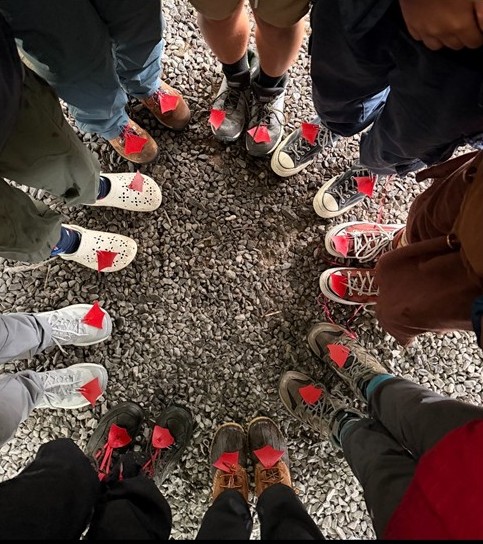
While there, I discovered that, apparently, guillemots are “simply the best seabird”. There was a widespread appreciation for Black Guillemots in specific, for reasons such as “they have very nice feet.” In fact, on the last day, we celebrated National Guillemot Appreciation Day (despite the official date being June 27th, and not the days we were there). The celebration included guillemot feet that could clip onto shoes, red, black, and white balloons and streamers, and even a song to the tune of ‘lollipop lollipop’. Videos and photos of the song were not permitted; therefore, I cannot attach them, but the lyrics included ‘guillemot guillemot, appreciate the guillemot’. This has left me wondering when Razorbill appreciation day will be established.

My time on Hog Island was very enjoyable.. It was an amazing opportunity, and I hope to return someday. I am very grateful to the Maine Young Birders Club and Friends of Hog Island for making it possible for me to attend this camp.
