Four YCAS members joined Mike Fahay on April 18 for an enjoyable jaunt through the Green Point Farm Wildlife Management Area. The field trip started dramatically when a large flock of Rusty Blackbirds zipped over us. In a stiff breeze, we wandered the area, finding some early warblers, getting excellent views of Bald Eagles, and spotting six species of ducks at various points on Merrymeeting Bay. We had a respectable total of 35 species, along with good conversation and fascinating wildlife information from Mike. His extensive knowledge of flora and fauna was truly impressive. This spot is well worth multiple visits, particularly during spring and fall migration.
Rotary Park: May 12, 2011
Thursday, May 12, proved to be like so many other days this May — cloudy and chilly, with a biting northeast wind. Nine intrepid birders braved the conditions, in hope of viewing recently arrived migrants. It seems the northerly windflow may have hindered migratory progress; we saw only six species of warblers. Over a period of three hours, we were finally able to tease out a total of 37 species, including some new arrivals, such as Eastern Kingbird, Warbling Vireo, and Baltimore Oriole. Near the “beach,” we were treated with a pair of Eastern Bluebirds, which appear to be nesting nearby.
Looking across the river from the picnic grounds, we watched a Spotted Sandpiper gamboling up and down a log that sported a roosting pair of Wood Ducks. Some of the group also observed a pair of very cooperative Brown Thrashers, on the ground for a long time, perhaps performing a kind of pair-bonding. In spite of the weather (it was not raining) the trip yielded some handsome birds.
Bird Day Draws a Crowd

Bill Grabin and Betsy Stevens check their wingspans against a banner showing species from around the world.
The Birding Challenge dovetailed nicely with an International Migratory Bird Day event held at the Wells Reserve on May 14. June Ficker and her bird-banding crew set up in the Laudholm barn, demonstrating their data-gathering procedures for curious onlookers. Their several captures included eastern wood-pewee and northern waterthrush. At the other end of the barn, a dozen kids put together free nest boxes while young brothers and sisters worked on cute bird crafts.
Outside, several people went on a bird walk that netted a nice list of warblers in addition to a white-eyed vireo and dozens of other species. Throughout the morning, an oversize checklist showed visitors what birds had been seen that day at the Wells Reserve and, thanks to call-ins from Birding Challenge teams, what had been found throughout York County.
The Center for Wildlife arrived just after noon to introduce families to hawk and owl “ambassadors,” non-releasable raptors cared for at the Cape Neddick rehabilitation facility.
Altogether, some 150 people attended Bird Day, one of several such events around the state supported by a grant from the Maine Outdoor Heritage Fund.
Birding Challenge 2011: It’s Up to You!
Nine teams numbering 20 birders took to the field on May 13th and 14th to raise funds in support of York County Audubon Conservation/Education efforts. We set records this year with numbers of folks in the field and total species seen: 170! Highlights of the day included a Barred Owl while snoozing by the Watsons, a mystery Blackbird that took lots of homework by Nancy Houlihan, and a several hundred bird flock of Brant geese lazing on the sea.
The birders did their part — thanks to one and all. The pizza supplied by Alfredo’s of Wells was wonderful and unmatched — their vegetarian is worth trying. And of course Linda Eastman did her job expertly keeping track of it all. Thank you, Linda.
Now it’s your turn! Please support this effort with checks or cash made out to the YCAS Birding Challenge, c/o Treasurer Linda Eastman.
Wednesday morning birding group: June 15, 2011
Good turnout for the walk at the Franciscan Monastery, Kennebunk!

Icy but Beautiful
At the (then) thermal nadir of the season sixteen thermally challenged troopers (as it turned out), attracted as moths to light to the instructive birding of Eric Hynes, joined him January 15 after navigating to The Nubble through Arctic smoke and sea fog at subzero temperatures. We flapped arms and rolled up collars while checking out the usual marine suspects around the light for a while, before Eric began to institute his program for keeping us thawed.
Such a benign beginning: we thought his plan stopped at wind-breaks and automobile heaters with quick stops at sheltered feeders just inside The Nubble and an exposed but brief gull-check on Long Sands Beach. Thence to the beach at Stage Neck and its slightly broken-in walk through 10 inches of snow. Eric charged up the hill (less broken in) where only one of us fell into the snow, and we did, after all, see a robin.
That was warmup for the walk around the point at Seapoint Beach (where another of us fell) and a final tour through the same kind of paths at Fort Foster. In all, we saw 40 species (under-reported by Eric as 39 on the listserve, because during a pit stop after Seapoint Beach he missed the pair of mallards inside Gerrish Island).
The high points have to have been the White-winged crossbills performing at the feeders at 94 Nubble Road and four or five American Pipits at Seapoint Beach, as well as the immature Cooper’s Hawk, first spotted by Marie Jordan in a window of an old house on an island in Portsmouth Harbor and patiently confirmed by several views thereafter. A rewarding day with a week’s worth of exercise to keep us warm while looking at birds in the glorious surroundings of a glistening bright day on Maine’s southern coast.
The species list:
- Harlequin Duck
- Common Eider
- White-winged Scoter
- Black Scoter
- Long- tailed Duck
- Surf Scoter
- Bufflehead
- American Black Duck
- Red-breasted Merganser
- Common Goldeneye
- Horned Grebe
- Red-necked Grebe
- Common Loon
- Great Cormorant
- Herring Gull
- Great Black-backed Gull
- Black Guillemot
- Purple Sandpiper
- Song Sparrow
- White-winged Crosbills (9)
- Carolina Wren
- Red-breasted Nuthatch
- Black-capped Chickadee
- House Finch
- Ring-billed Gull
- Cedar Waxwing
- American Robin
- Northern Mockingbird
- Northern Cardinal
- House Sparrow
- American Pipit
- European Starling
- Blue Jay
- American Crow
- Mallard
- Cooper’s Hawk (imm)
- Brown Creeper
- Rock Pigeon
- Mourning Dove
- American Goldfinch
Correspondence: Cory’s College Fund
Dear Ms. Zimmerman,
I would like to thank you and the York County Audubon Society for the June Ficker Memorial College Fund. So far school has been going well for me, and in particular I have found a lot of interest for my terrestrial wildlife and wetland conservation classes. My professor, Dr. Perlut, is very interested in birds himself, and has been banding Savannah Sparrows in Vermont for the last nine years. I hope to work with him this summer conducting bird count surveys along the Saco River. I am also looking forward to taking a class on bird banding, which will be offered in the fall. I am very grateful for the financial aid you have provided for my educational pursuits. I also appreciate the skills and knowledge I have received through working alongside June Ficker last summer. I wish you all the best.
Sincerely, Cory French
Quest for 300 Gets Tougher
Last time I wrote that in 2010, birders using eBird had reported seeing 298 species in York County. Since then, I’ve discovered a quirk in that data: In eBird, “species” is more than species. The tally is not as close to 300 as I thought!
Most birders have spotted birds that they couldn’t nail down to species, but many still make note of them. Rare is the field notebook without any “accipiter sp.” or “empidonax sp.” to account for those hawks or flycatchers that just didn’t reveal enough for a positive identification. Those entries and many similar ones are still acceptable, though, to eBird. For example, the York County list contains five scoter and three scaup “species.”
Hybrids are allowed on the list, too. Brewster’s Warbler, that handsome combination of Blue-winged and Golden-winged Warblers, gets its own line, as does the Mallard/American Black Duck mix.
Altogether, the latest count for 2010 shows 21 non-species, leaving just 278 true species on the list. Is 300 even attainable? It’s still worth a try. So far, eBirders have reported 116 species in 2011.
If you haven’t checked out ebird.org already, now is a good time to browse around. Registering lets you record the birds you see, keep track of your bird lists, explore dynamic maps and graphs, share your sightings, join the eBird community, and contribute to science and conservation. If you have previously registered for any BirdSource project, you can use your existing account on eBird.
But if you’re not quite ready to create an account, you can still use eBird to view graphs, charts, and maps showing the distribution and abundance of birds reported by thousands of other participants.
Wonder where to get started? Try this: visit ebird.org, follow the “About eBird” tab, and look near the bottom of the list of links in the right column for “Occurrence Maps.” Click to see how scientists have used the eBird data to create fascinating animated maps for many species. It’s amazing to watch the yearly ebb and flow of migratory populations on a base map of the United States, and a wonderful demonstration of the power of cooperative science.
AOU Changes & ABA Area Birds
The American Ornithologists’ Union published the 51st supplement to its check-list of North American Birds in July of 2010. Here is a brief summary of the changes of interest to ABA birders. The updated AOU checklist, now with 2070 species, can be found at www.aou.org/checklist/north. The following splits affected ABA area birds: Black Scoter (Melanitta nigra) was split into American and Eurasian Species. The American species retains the common name Black Scoter (M. americana) and the Eurasian Scoter becomes Common Scoter (M. nigra). The Eurasian species has not yet been reported in the ABA Area.
Whip-poor-will (Caprimulgus vociferus) was split into two species: Eastern Whip-poor-will (C. vociferus) and Mexican Whip-poor-will (C. arizonae). Winter Wren (Troglodytes troglodytes) was split into three species: Eurasian Wren (T. tryglodytes), Winter Wren (T. hiemalis), and Pacific Wren (T. pacificus).
Pictures and texts comparing all of these splits can be found in Sibley’s Guide to Birds and the National Geographic Field Guide to North America. Songs can be found in the Stokes’ Field Guide to Bird Songs as well as on www.xeno-canto.org. Draft range maps for all species may be seen at www.sibleyguides.com.
Individual Landowners’ Role in the Bobolink Summertime Drama

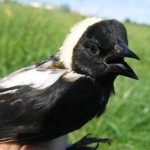
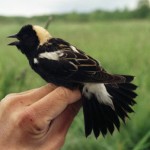
Male Bobolink in the hand. Photo by Noah Perlut.
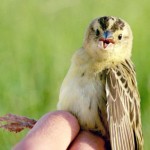
Each summer aerial dramas help define the sights and sounds of New England’s agricultural landscape. Male bobolinks, jet black with a bright yellow nape and white tuxedo-like markings on their backs, soar into the air singing so wildly they almost seem confused and then land like butterflies on the tall grass. Female bobolinks, golden and bronze, sleek, with delicate stripes on top of their heads, like to test their mates and neighbors, making a whine-like call and rocketing into the sky to see which male can keep pace.
Unfortunately, these dramas are acted out less and less each summer. According to the Breeding Bird Survey, if Maine had 100,000 breeding Bobolinks in 1966, by 2007 there were slightly less than 60,000 (-1.25% annual decline). Two factors explain these declines. First, the total amount of grassland habitat has declined. In 2007 Maine had 197,757 acres of managed grassland (14,432 acres in York Country), a 50% decline from 1987.
Despite this decline, the state still has suitable, albeit reduced, habitat for grassland songbirds, mainly those lands owned by private individuals. The second cause of decline is linked to increasing intensity of management, where farmers cut hay earlier and more frequently through the season. Such increase is advantageous because forage harvested earlier in the season has greater nutrition, which leads to greater milk production in dairy cows.
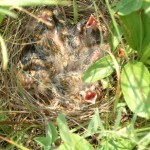
I have studied the effects of increased management intensity on Bobolinks, Savannah Sparrows and Eastern Meadowlarks in Vermont for the last nine years. The big picture of this work is clear: as intensity of management increases, birds’ reproductive success and their probability of surviving to the next year decreases. For example, a female Bobolink breeding on a hayfield cut in late-May and again in early-July has zero reproductive success. Meanwhile a female breeding in a field cut on August 1 will successfully produce at least three young.
Can both intensive hay-farmers and birds co-exist? Yes! Vermont’s National Resource Conservation Service (NRCS) recently created an incentive payment for intensively managed hayfields. Farmers are encouraged to cut as early as possible (must be before 31 May) and then delay their second harvest for 65 days (compared to the typical 35-40 day delay). In return farmers receive $135 per acre. This modest change in the timing of haying increased the average Bobolink reproductive success from zero to three offspring per year.
An open dialog between farmers, conservationists, agencies and researchers developed a mutually satisfying management plan in Vermont, and a Maine-specific model can be created too. The Bobolink’s future in Maine will indeed be determined by the management decisions of each individual landowner.
Noah Perlut is an Assistant Professor in the Department of Environmental Studies at the University of New England
Read an article about Dr. Perlut’s work in the Burlington Free Press.
Birding Challenge 2011: Announcement
Did you know that the majority of the York County Audubon financial outreach is supported by our Birding Challenge Fund Raiser. We support great relationships with The Center for Wildlife, The Puffin Project, the Kennebunkport Conservation Trust, and other York County conservation organizations.
Because of these relationships we can offer exciting community based programs like our “Winter Wildlife Day,” our Piping Plover Educational Program, and we can enjoy a beautiful spot for our Annual Dinner.
The 2011 Birding Challenge will happen on the 13th & 14th of May. We search for birds from 5:00pm on May 13th and complete our 24 hour effort in the auditorium of Laudholm Farm at the Wells Reserve doing a compilation and eating pizza.
You can join us! Bird with us! Raise funds and contribute to our support of the York County Conservation effort. Call Pat Moynahan for additional information (284-5487).
Full House for Winter Wildlife Day
On February 24th the auditorium at the Wells Reserve was filled with the sounds of joyful kids and thankful parents, Yes, it was our Winter Wildlife Day! We cosponsored this event with the Center for Wildlife and the Wells Reserve at Laudholm. A total of 106 individuals of which over half were children attended the morning session for the Center for Wildlife presentation. This well received live animal show included a Red-tailed Hawk, a Barred Owl, and Edna the albino porcupine. Kids and parents were delighted with these guests, as confirmed by their many pertinent questions and their quiet, respectful enthusiasm.
After this about 40 individuals went snowshoeing and tracking with Tim Spahr of the Maine Warden Service and Bill Grabin of YCAS. Those remaining in the auditorium made binoculars with Bob Watson of YCAS and/or tracks with Suzanne Eder of the Wells Reserve. Later all joined in hot chocolate served by Monica Grabin of YCAS.
A total of 58 folks, including 31 children, attended our afternoon session which repeated the presentation and activities. It was very rewarding to see grandparents and parents fully engaged with their little ones in the Wildlife Day, making and wearing binoculars, tracking, and listening to an educational presentation.
This community event was greatly appreciated and praised by many parents, “Thank you for this free school vacation event.” It took a lot of coordination and cooperation to pull it together. It does take a village to raise a child. Thanks to all who made it work.
Please consider how you might work with us to make a gift of birding and conservation available to our communities.
Who did you introduce to birding today?

Barred Owl. Photo by Marie Jordan.
I had a call at at 8:30 this morning. It was my 7-year-old granddaughter excitedly telling me that they had a Barred Owl in their yard (Maine woods)… right then! She wanted me to bring her little Peterson bird book over that I started for her, so she could put a Barred Owl in it. I did, and gave her a little notebook to write in, since she is now learning to read and write. I was nearly 50 before I was introduced to birding, thanks to the Beaver Lake Nature Center near me in central New York. So, here comes another generation of bird watchers!
YCAS Annual Meeting
Our annual meeting will be held at the Kennebunkport Conservation Trust, 7 Gravelly Brook Road, Kennebunkport.
- 6:45pm: Annual Business Meeting
- 7:00pm: Social Time & Refreshments
- 7:30pm: Program — Songbird Migration in the Gulf of Maine: Past, Present, and Future
For our program, Rebecca Holberton and Adrienne Leppold from the University of Maine Laboratory of Avian Biology will help us to see how what happens in the Gulf of Maine affects us, our birds, and other wildlife.
One of the nation’s leading bird biologists, Rebecca Holberton, and her graduate student Adrienne Leppold have discovered a ton of new information about Maine’s songbird migration. Information gathered by a cooperative of Canadian and U.S. nonprofit organizations, government agencies, and university researchers have been shedding light on the routes our birds use. Tonight we will learn the amazing story of the discovery of a superhighway for songbirds migrating between Canada and South America and what it implies for the future.
The meeting and program are free, but reservations are required before June 1. Please call 207-967-4486 or email davidd@roadrunner.com to reserve your spot.
Photographing Birds and Natural History
Phippsburg writer, gardener and natural history photographer Robin Robinson will entertain us with beautiful photos and video of birds, beasts, wildflowers and natural history she has taken in Maine. The program will include a smattering of hints and techniques for those who would like to get better photos. Robin’s photographs have been in numerous publications. On Open Salon.com, her combined work has earned Editor’s Pick several times and has been selected three times for the prestigious Maine Photography Show. Select photographic prints will be available for sale after the program.
Quest for 300
How many bird species can be seen in York County in a single year? A dedicated birder can tally 200 or more with reasonable effort, but what if a bunch of birders ranging from casual watchers to serious listers contributed to a single collective list? They have, on eBird, and the 2010 total was 298. [Edit: Not so fast! See my followup on what eBird counts as “species.”]
eBird.org is a real-time online checklist program launched in 2002 by the Cornell Lab of Ornithology and National Audubon Society. It makes vast numbers of bird observations accessible and usable. We’re watching the monthly lists for York County and will report what we find in The Harlequin. Watch the next issue to learn how you can share your bird records.
Song Sparrow by the Gazebo
Watched the sparrow fly in to land on the gravel surrounding the Wells Reserve gazebo. It hopped around pecking for a while. Went under the gazebo and came back out.
Woodcock Walk
Meet Paul Dest at the Wells Reserve at Laudholm to experience the aerial courtship display sometimes called the “sky dance.”
- Registration required at 646-1555
- $5 members, $7 non-members